

Fair-faced concrete—the marble-like, architectural finish that requires no additional surface treatment—represents the pinnacle of concrete craftsmanship. Achieving this level of quality isn’t about luck or expensive materials alone. It requires understanding how three critical factors work together: mix design, formwork type, and release agent selection.
What is Fair-Faced Concrete?
Fair-faced concrete (also called architectural concrete or exposed concrete) is concrete that, upon formwork removal, presents a surface so smooth and uniform that it requires no additional finishing, coating, or treatment. The surface quality rivals polished stone, with:
- Surface roughness (Ra): < 0.5μm (mirror finish)
- Color uniformity: Consistent across entire surface
- Defect-free: No bugholes, stains, or blemishes
- Geometric accuracy: Meets tight dimensional tolerances

The Three Pillars of Fair-Faced Concrete
Achieving perfect fair-faced concrete requires excellence in three areas:
1. Mix Design
2. Formwork Selection
3. Release Agent Technology
These factors are interdependent—weakness in any one area compromises the final result.
Pillar 1: Mix Design
Key Requirements
Cement Content and Type
- Cement content: 350-450 kg/m³
- Cement type: White Portland cement for color consistency
- Low heat generation: To minimize thermal cracking
- Consistent quality: From batch to batch
Aggregate Selection
- Maximum aggregate size: 20mm or smaller
- Grading: Well-graded for optimal workability
- Shape: Rounded or cubical (avoid flaky/elongated)
- Cleanliness: Washed, free of organic matter
Water-Cement Ratio
- Target w/c ratio: 0.35-0.45
- Consistency: Controlled within ±0.02
- Workability: Slump 120-180mm (adjust with superplasticizer)
Admixtures
- Superplasticizers: For workability without increasing water
- Air-entraining agents: Controlled air content (3-5%)
- Retarders: For extended workability in hot weather
- Viscosity modifiers: To reduce segregation
Common Mix Design Mistakes
Mistake 1: High Water Content
Problem: Excessive water increases:
- Shrinkage and cracking
- Surface porosity
- Color variation
Solution: Use superplasticizers to achieve workability with low w/c ratio.
Mistake 2: Inconsistent Batching
Problem: Variation in mix proportions causes:
- Color differences
- Strength variation
- Surface texture inconsistency
Solution: Automated batching systems with quality control.
Mistake 3: Poor Aggregate Quality
Problem: Dirty or poorly graded aggregates create:
- Surface blemishes
- Color contamination
- Reduced workability
Solution: Source high-quality, washed aggregates.
Pillar 2: Formwork Selection
Formwork Types for Fair-Faced Concrete
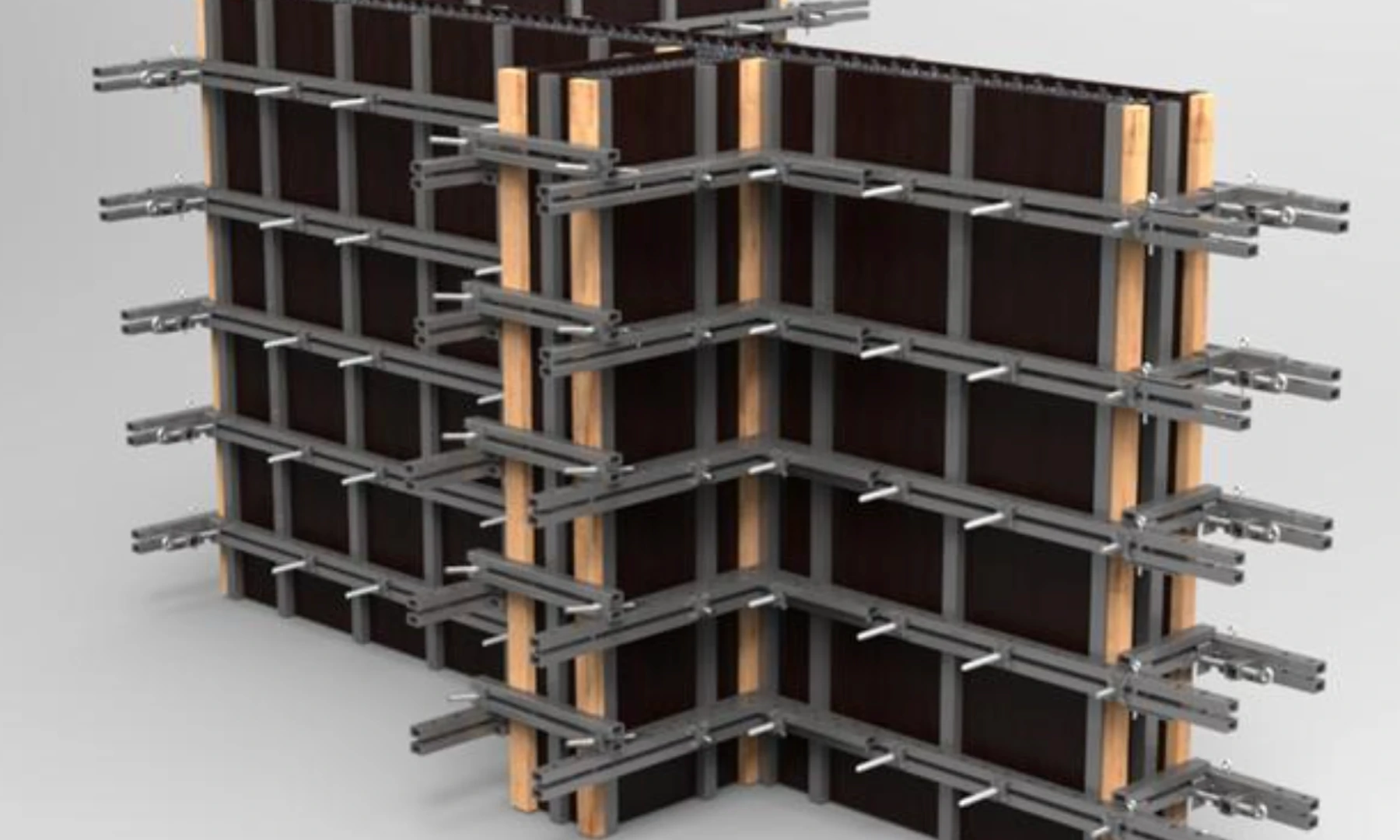
1. Steel Formwork
Advantages:
- Smooth surface finish (Ra < 0.3μm possible)
- Dimensional accuracy (tight tolerances)
- Durability (hundreds of uses)
- Consistent quality across multiple uses
Disadvantages:
- High initial cost
- Heavy weight (requires crane)
- Thermal conductivity (affects curing)
Best for: Large, repetitive elements (walls, columns)
2. Aluminum Formwork
Advantages:
- Lightweight (easier handling)
- Smooth finish (Ra < 0.5μm)
- Corrosion-resistant
- Good dimensional stability
Disadvantages:
- Higher cost than plywood
- Softer surface (more susceptible to damage)
- Thermal expansion considerations
Best for: Medium-scale projects, complex geometries
3. High-Density Plywood (HDO/MDO)
Advantages:
- Cost-effective for one-time use
- Good surface finish with proper treatment
- Easy to cut and shape
- Lightweight
Disadvantages:
- Limited reusability (5-10 uses)
- Surface quality degrades with use
- Susceptible to moisture damage
Best for: Custom shapes, small-scale projects
Formwork Surface Preparation
Surface Treatment
- Sanding: Remove surface imperfections
- Sealing: Apply sealant to prevent moisture absorption
- Coating: Apply release agent-compatible surface treatment
- Inspection: Verify smoothness and cleanliness
Critical Requirements
- Surface roughness: Ra < 1.0μm
- Flatness: < 2mm deviation over 2m
- Cleanliness: Free of dust, oil, and contaminants
- Sealing: Properly sealed to prevent concrete penetration
Pillar 3: Release Agent Technology
The Chemical Barrier Principle
Release agents work by creating a chemical barrier that forms a physical separation film between the formwork and concrete. This is not simply lubrication—it’s a sophisticated chemical process.
How Release Agents Create Separation
Step 1: Film Formation
When applied to formwork, the release agent forms a micro-thin film (typically 2-5 microns):
- Uniform coverage across entire formwork surface
- Chemical bonding to formwork material
- Barrier creation against concrete adhesion
Step 2: Chemical Interaction
During concrete placement:
- Non-reactive barrier: Release agent doesn’t react with concrete
- Surface tension reduction: Prevents concrete from wetting formwork
- Air permeability: Allows air escape (prevents bugholes)
Step 3: Clean Separation
Upon formwork removal:
- Clean release: Concrete separates cleanly from formwork
- No residue: Neither on formwork nor concrete
- Surface preservation: Maintains formwork for reuse
Types of Release Agents
1. Water-Based Wax Emulsions
Composition:
- Base: Water-soluble wax particles
- Emulsifiers: For stable dispersion
- Additives: For enhanced performance
Advantages:
- Low viscosity: Allows air escape
- Non-staining: Clean, white concrete finish
- Environmentally friendly: Low VOC, biodegradable
- Formwork protection: Extends formwork lifespan
Best for: Fair-faced concrete, architectural applications
2. Oil-Based Release Agents
Composition:
- Base: Mineral or vegetable oils
- Thickeners: For viscosity control
- Additives: For performance enhancement
Advantages:
- Good release: Effective separation
- Water resistance: Suitable for wet conditions
Disadvantages:
- High viscosity: Can trap air (bugholes)
- Staining risk: May discolor concrete
- Environmental impact: Higher VOC content
Best for: Structural concrete (non-architectural)
3. Reactive Release Agents
Composition:
- Chemical components: React with formwork surface
- Barrier formation: Creates permanent or semi-permanent barrier
Advantages:
- Long-lasting: Multiple uses without reapplication
- Excellent release: Superior separation quality
Disadvantages:
- Higher cost
- Application complexity
- Compatibility requirements
Best for: High-volume, repetitive work
Selecting the Right Release Agent
For Fair-Faced Concrete
Critical Properties:
-
Low Viscosity (< 20 cP)
- Allows air escape
- Prevents bughole formation
-
Non-Staining
- Maintains concrete color
- No discoloration or contamination
-
Formwork Compatibility
- Works with your formwork type
- Doesn’t damage formwork surface
-
Environmental Compliance
- Low VOC content
- Biodegradable
- Safe for workers
-
Consistent Performance
- Reliable release
- Uniform application
- Predictable results
The Holistic Approach in Practice
Case Study: High-End Residential Tower
Project Requirements:
- Class A fair-faced concrete
- White concrete finish
- Ra < 0.5μm surface roughness
- Zero defects tolerance
Implementation:
Mix Design
- White Portland cement: 400 kg/m³
- w/c ratio: 0.38
- Superplasticizer: 1.2% by cement weight
- Maximum aggregate: 16mm
Formwork
- Steel formwork for walls
- Surface preparation: Sandblasted, sealed
- Surface roughness: Ra 0.2μm
Release Agent
- Water-based wax emulsion
- Application: 0.15mm uniform film
- Viscosity: 8 cP
Results:
- Surface quality: Ra 0.4μm (exceeded requirement)
- Color uniformity: Consistent across all elements
- Defect rate: < 0.1% (well below 1% tolerance)
- Formwork reuse: 45 cycles without degradation
- Client satisfaction: Exceeded expectations
Common Failures and Solutions
Failure 1: Good Mix + Poor Formwork
Symptom: Surface imperfections, texture variation
Solution: Upgrade formwork surface quality or replace formwork
Failure 2: Good Formwork + Wrong Release Agent
Symptom: Bugholes, staining, poor release
Solution: Switch to appropriate release agent (water-based for fair-faced)
Failure 3: Perfect Setup + Inconsistent Mix
Symptom: Color variation, strength issues
Solution: Implement quality control for batching and mixing
Best Practices Checklist
Pre-Placement
- Mix design optimized for fair-faced concrete
- Formwork surface prepared and inspected
- Release agent selected and tested
- Application equipment calibrated
- Quality control procedures established
During Placement
- Consistent concrete delivery
- Proper consolidation (vibration)
- Temperature control
- Quality monitoring
Post-Placement
- Proper curing procedures
- Formwork removal timing
- Surface inspection
- Quality documentation
Technical Specifications
Surface Quality Standards
| Class | Ra (μm) | Application |
|---|---|---|
| A | < 0.5 | Architectural, exposed |
| B | 0.5-1.0 | High-quality structural |
| C | 1.0-2.0 | Standard structural |
Release Agent Performance
| Property | Requirement | Test Method |
|---|---|---|
| Viscosity | < 20 cP | ASTM D445 |
| Film Thickness | 2-5 μm | Coating thickness gauge |
| Release Efficiency | 100% | Visual inspection |
| Staining | None | Colorimeter |
| VOC Content | < 50 ppm | GC-MS |
Conclusion
Achieving marble-like fair-faced concrete is not achieved through any single factor, but through the integration of three critical elements:
- Optimized mix design provides the foundation
- Quality formwork creates the template
- Advanced release agents ensure perfect separation
The release agent, often overlooked, plays a crucial role. Modern water-based wax emulsions create the chemical barrier that forms a physical separation film, enabling:
- Flawless surface finishes (Ra < 0.5μm)
- Clean, white concrete (no staining or discoloration)
- Defect-free surfaces (no bugholes or blemishes)
- Formwork protection (extended lifespan)
Understanding how these three pillars work together is the key to consistent, high-quality fair-faced concrete.
