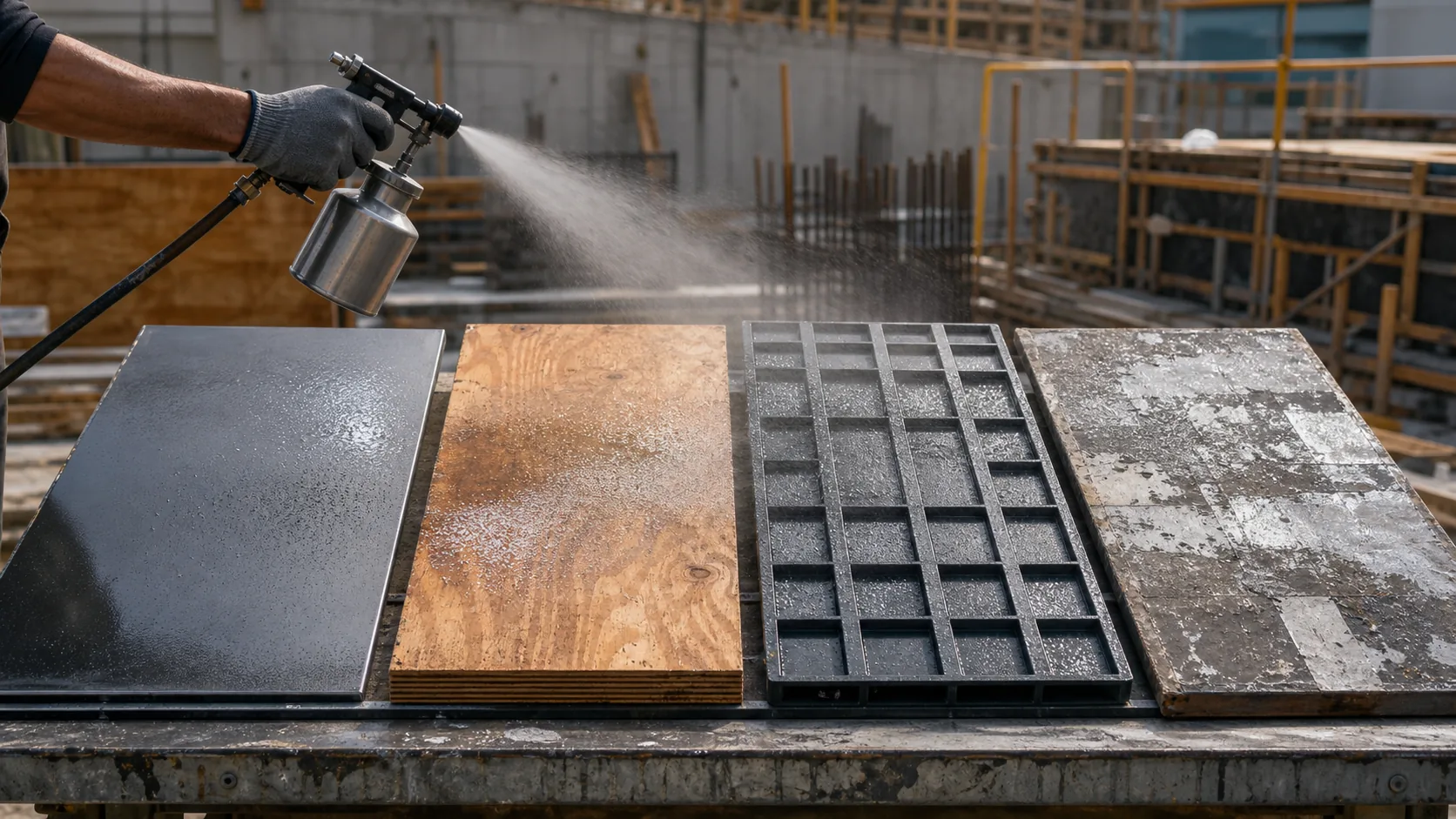
Choosing a release agent by brand alone is the wrong starting point. Formwork material changes absorbency, surface energy, heat transfer, and how much residue the face can hold. A product that behaves cleanly on steel can still stain wood, and a product that looks fine on plastic can still pool on a worn panel. When the form face changes, the film behavior changes with it.
That is why the first question on site should not be “Which product do we have?” It should be “What is the formwork made of, and what kind of finish does it need to produce?”
For the broader application context, read Release Agent Application: Spraying, Coverage, and Quality Control and Can Too Much Release Agent Cause Staining on Concrete?.
Why Formwork Material Matters
The form face controls how the release film sits, dries, and separates. Some surfaces absorb part of the product. Others hold it on top. Some look smooth but still trap heavy areas in corners, welds, or patched zones.
That means a good release-agent choice is always a mix of chemistry and surface behavior. If you ignore the material, you are only solving half the problem.
Steel Formwork
Steel is usually the easiest material to control because it does not absorb much product. That makes it suitable for thin, even films and repeatable finishes.
The risk is not absorption. The risk is over-application at joints, edges, and overlap zones. If the surface already has residue, rust, or old cement paste, the release film can become uneven very quickly.
Steel formwork usually works best with a light, controlled spray and a careful check around seams and corners before casting.
Wood Formwork
Wood behaves very differently. It absorbs more release agent, more moisture, and more variation from one panel to another. A spray pattern that looks fine at a distance can still leave the surface uneven.
If the wood is dry, it may pull product into the surface. If it is patchy or worn, some zones can stay dry while others become heavy. That is why wood usually needs the most consistent coverage discipline.
On visible finishes, wood formwork is often where people first discover that “more product” is not the same thing as “better release.”
Plastic Formwork
Plastic is usually low-absorbency and smooth, so it does not soak up material the way wood does. That makes it look easy at first. In practice, it can be the easiest surface to over-apply.
Because the face does not drink in the release agent, heavy passes can sit on top and create pooling, shine, or residue marks. Plastic formwork still needs a thin film, not a wet coating.
If the surface looks clean but glossy, the film is probably heavier than it should be.
Repaired or Worn Formwork
Repaired panels are a category of their own. Sanded patches, fillers, old residue, dents, and worn edges all change how the release film behaves.
These panels should be treated as high-risk zones, not as normal formwork. The safest approach is to inspect the repair areas closely, confirm they are clean and dry, and pay extra attention to film thickness around the repaired spots.
Quick Decision Guide
| Formwork type | Main risk | What to check first | Best spray habit |
|---|---|---|---|
| Steel | Overlap staining | Joints, welds, edges | Thin, even passes |
| Wood | Uneven absorption | Dry spots and heavy spots | Slow, consistent coverage |
| Plastic | Pooling and residue | Gloss, puddles, corners | Very light film |
| Repaired panels | Local defects | Patches and worn zones | Targeted inspection |
How to Check the Film Before Casting
Before the pour, walk the surface and look for puddles, shine, missed corners, and any area that looks visibly heavier than the rest. A good film should be present but not obvious.
If the form looks wet, it is probably too heavy. If the surface looks dry in some places and glossy in others, the coverage is inconsistent. For exposed concrete, those small differences can show up immediately after stripping.
Common Mistakes
The most common mistake is using the same spray volume on every formwork material. Another is assuming that a smooth-looking panel will always behave the same way as a porous one.
People also forget to treat repairs as separate risk zones. That is often where the worst stains or sticking show up first.
Conclusion
Material first, product second. Steel, wood, plastic, and repaired panels all need slightly different release-agent behavior, even when the same chemistry is used.
If the project needs a clean exposed finish, choose the product after you understand the form face, not before. That small change in sequence usually saves a lot of trouble later.
If you want to compare this with a broader surface-quality workflow, continue with Fair-Faced Concrete: The 3 Factors That Decide Surface Quality.