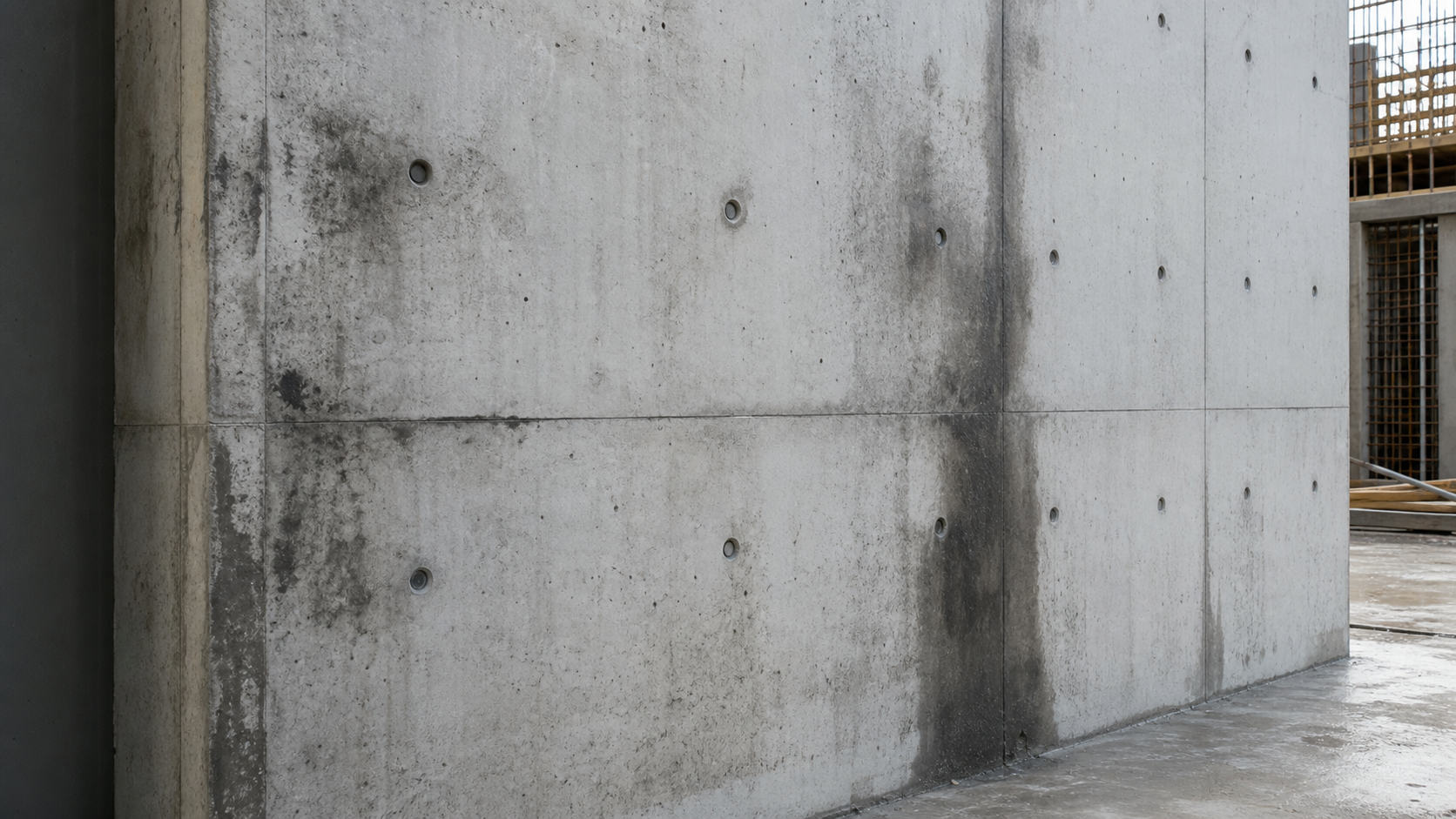
Yes, too much release agent can stain concrete. On fair-faced concrete, over-application often shows up as dark patches, oily shadows, uneven tone, or localized marks near joints and spray overlap zones. The risk becomes even higher when crews use waste oil, dirty formwork, or spray without any real coverage control.
The key point is simple: a release agent should form a thin, uniform film. It should not sit on the form like a wet layer of oil. If the material is excessive, the interface between formwork and concrete becomes inconsistent, and the final surface starts to show it.
If you want the broader context first, read Release Agent Application: Spraying, Coverage, and Quality Control and Water-Based Release Agent vs Waste Oil: Why the Cheap Choice Costs More.
What Staining From Excess Release Agent Usually Looks Like
Staining caused by over-application does not always look dramatic at first. On some projects, it appears as a faint darkening that becomes obvious only when adjacent panels are compared. On others, it shows up as oily marks, uneven gloss, or dirty-looking zones after demolding.
Typical signs include dark patches, local color variation, shiny residue, and marks concentrated near corners, joints, and repeated spray passes. If one part of the wall looks visibly heavier or dirtier than the rest, excess release material is one possible cause.
Why Too Much Release Agent Causes Staining
The release film is supposed to separate the form and the concrete cleanly. When the layer becomes too heavy, it stops behaving like a controlled film and starts behaving like residue.
One problem is that thick areas create uneven contact at the form face. The concrete surface does not cure against the form in a consistent way, so the final color can vary from zone to zone. Another problem is that excess material can gather in joints, at the bottom of forms, or in spray overlap areas, leaving concentrated marks that remain visible after stripping.
Heat, humidity, and poor timing can make the situation worse. A product that might behave acceptably in one condition can become unstable when the form is hot, damp, or sprayed too early before pouring. That is one reason weather conditions should never be separated from application control. For that topic, see How Temperature and Humidity Affect Release Agent Performance.
Over-Application Is Not the Only Cause
Excess release agent is a common cause of staining, but it is rarely the only possible cause. Dirty formwork, old cement paste left on the form face, inconsistent concrete mix water, poor vibration near the surface, and low-grade waste oil can all produce similar-looking defects.
In other words, staining is usually a system problem. Still, over-application is one of the easiest causes to overlook because crews often assume that more material gives more protection. On exposed concrete, that assumption is often wrong.
How to Tell If the Problem Is Over-Application
There are a few practical clues. If the stains follow spray overlap patterns, appear more heavily near edges and joints, or are concentrated where the form looked visibly wet before casting, over-application is likely part of the problem.
Another clue is residue on the form itself. If a wipe test leaves an oily trace, or if liquid was visibly collecting at the bottom of the form, the film was probably too heavy. If adjacent pours handled by different crews produce different color results, application discipline should be reviewed before blaming the concrete.
How Much Release Agent Should Be Applied Instead
The target is a thin, continuous, uniform film. The form should look lightly coated, not soaked, dripping, or glossy with excess liquid. There should be no puddles, no runs, and no heavy accumulation in corners.
That is why application should be managed by coverage standard, spray pattern, and inspection, not by guesswork. A crew that sprays by habit instead of by control usually creates variation sooner or later. For a more detailed process explanation, see Release Agent Application: Spraying, Coverage, and Quality Control.
Best Practices to Prevent Staining
Start with clean formwork. Then use a consistent spray pattern, avoid double passes in corners and joint areas, and give the film enough time to settle before concrete placement. If the project cares about appearance, test the application on a small sample panel before full production.
It also helps to standardize who sprays, how they spray, and what visual standard they use before the pour is approved. On fair-faced work, repeatability matters just as much as product choice. For a broader surface-quality view, read Fair-Faced Concrete: The 3 Factors That Decide Surface Quality.
Why Water-Based Release Agents Are Easier to Control
Water-based release agents are not magic, but they are usually cleaner and more predictable than waste oil when the project requires a visible finish. They are better suited to exposed architectural concrete because they reduce the chance of heavy oily residue and make it easier to work toward a uniform surface result.
That does not mean any water-based product will succeed automatically. Application still matters. But if the project is sensitive to appearance, cleanup, and environmental control, a proper water-based system is usually a better starting point than waste oil.
Conclusion
Too much release agent can absolutely stain concrete. In practice, the issue usually comes from poor coverage control, dirty formwork, unsuitable materials, or several of those problems working together.
For fair-faced concrete, the goal is not more release agent. The goal is a thinner, more uniform film that supports clean separation without contaminating the surface.
If you are dealing with dark patches or uncertain surface marks, send us a photo of the concrete face and the formwork condition. That usually makes the cause much easier to judge.