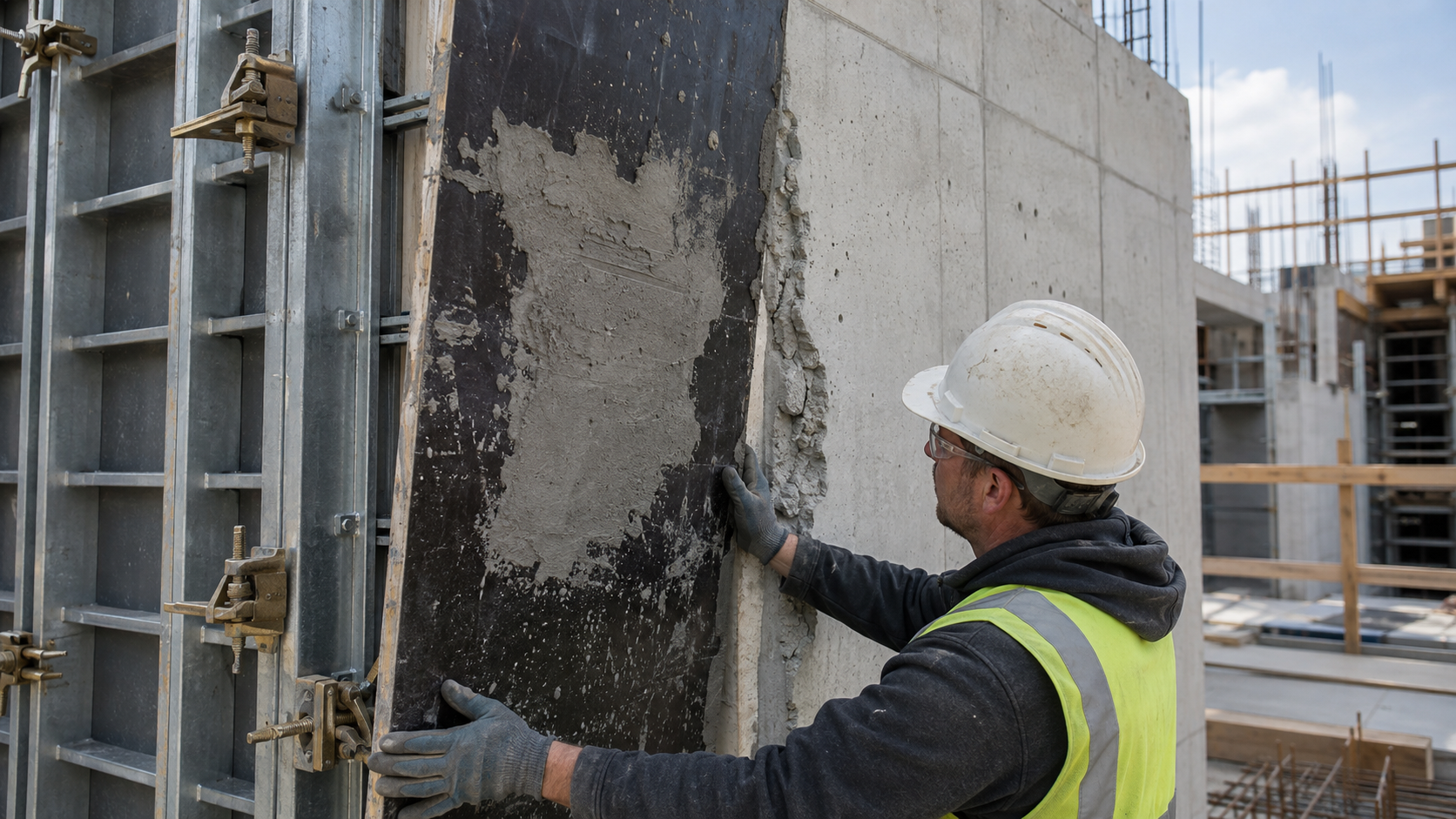
Concrete sticking to formwork is usually not a matter of the stripping crew using too little force, and it is not always solved by spraying more release agent. It means that the concrete, form face, release film, and stripping conditions have failed to create a stable separation interface.
Typical signs include torn or pulled concrete at stripping, cement paste left on the form face, damaged corners, or unusually high force needed to separate the panel. If the cause is not identified, increasing the release-agent volume on the next pour can simply replace sticking with oily shadows, dark patches, and surface contamination.
A more reliable sequence is to record the shape and location of the sticking first, then check the formwork condition, film coverage, concrete conditions, and stripping timing. This article provides a practical first diagnosis so the team can decide whether to clean the form, adjust spraying, delay stripping, or repeat a compatibility mock-up.
If the formwork material has not yet been matched to the release agent, start with How to Choose a Release Agent by Formwork Material. If the problem seems connected to spraying, compare it with Release Agent Application: Spraying, Coverage, and Quality Control.
First Confirm It Is Sticking
Not every defect found after stripping is caused by sticking. Separate the symptoms first so the investigation starts in the right place.
| Site symptom | More likely issue | What to observe first |
|---|---|---|
| Concrete is pulled or torn, with cement paste on the form | Sticking or separation-interface failure | Form residue, missed coverage, and stripping timing |
| Many small holes, but little residue on the form | Bugholes or an air-release problem | Vibration, concrete workability, and film condition |
| Dark patches, oily shadows, or local shine | Film over-application or uneven distribution | Overlap zones, pooling, and drying time |
| Large surface loss or deep damage | A possible structural or construction-quality issue | Damage depth, exposed reinforcement, and concrete strength |
If the damage is deep, keeps spreading, exposes reinforcement, or may affect the member’s capacity or durability, preserve the records and ask the project technical team or a structural engineer to assess it. This article is for initial site diagnosis and does not replace engineering acceptance.
Four Common Causes of Concrete Sticking
1. The formwork surface is not ready for stripping
The form face is the first interface that contacts the concrete. Dust, old cement paste, rust, wood fibers, old release-agent residue, and standing water can all interrupt the continuity of the release film.
Steel forms often have problems around welds, joints, edges, and old cement scale. Wood can have uneven absorption, dry patches, or raised fibers. Plastic usually has low absorption, so excess release agent can pool on top. Repaired panels can combine roughness, different absorption, and material incompatibility in one area.
If sticking repeatedly appears on one panel, one joint, or one repaired zone, inspect that local surface first. Do not assume that the whole release-agent batch has failed.
2. The release film is missed, too thin, or too thick
The purpose of a release film is to create a thin, continuous separation layer, not to leave the form visibly wet or glossy.
Missed coverage or a film that is too thin can let concrete contact the form directly. A film that is too thick can pool at corners, joints, or overlap bands and create unstable residue or contamination. The same spray volume will also behave differently on different formwork materials.
Review these points carefully:
- Was the product diluted according to its instructions, or was the ratio changed on site?
- Did the nozzle, pressure, spray distance, or operator speed change?
- Were corners, joints, the lower part of vertical panels, and repaired areas missed or overloaded?
- Was the sprayed surface exposed to rain or dust, or left waiting too long before the pour?
- Was the film stable and ready when casting began?
Overall shine is not proof of good coverage. Walk the form face before casting and mark any abnormal areas.
3. The concrete is not ready for stripping
Concrete strength, curing temperature, member geometry, and stripping time all affect stripping resistance. Low temperatures, inadequate curing, a changed mix, or early stripping can make the concrete surface more vulnerable as it separates from the form.
This often appears when a formwork and release agent that normally perform well suddenly begin sticking after a cold pour, a night pour, a change in concrete temperature, or a change in the work schedule. In that situation, do not only increase the release-agent volume. Check the actual stripping conditions and project requirements.
If stripping happens too early, a thicker release film cannot replace the required concrete strength and curing. Follow the project specification, concrete strength requirement, and technical method statement when setting the stripping condition.
4. Concrete, vibration, and local geometry amplify the problem
Concrete workability, bleeding, placement method, and vibration affect the interface pressure and how air leaves the form face. If concrete remains in one local area for too long, or if the vibrator stays close to the form, defects may become more visible around corners and narrow sections.
Tie-rod locations, embeds, narrow walls, deep ribs, sharp corners, and complex returns can also increase stripping resistance. If sticking occurs only in these areas, include the geometry and stripping path in the investigation instead of increasing the spray volume over the whole panel.
Use Location to Set the Priority
The location often gives better diagnostic information than the assumption that the release agent is at fault. Use the table below to choose the first check.
| Sticking pattern | First causes to suspect | Next action |
|---|---|---|
| Across most of the panel | Release-film system, form cleanliness, or stripping condition | Review product, spray record, curing, and stripping time |
| Scattered patches or bands | Missed coverage, overlap, nozzle condition, or operator speed | Check spray path, film coverage, and equipment |
| At joints, corners, or welds | Local cement build-up, pooling, old residue, or difficult coverage | Clean these areas and inspect them separately |
| At repaired or sanded zones | Uneven absorption or roughness | Validate the repaired area as a separate formwork condition |
| Only during cold weather or early stripping | Concrete strength, curing, or stripping time | Check strength and stripping requirements first |
| Only on one formwork material | Formwork and film compatibility | Run a representative mock-up instead of copying the spray volume |
One important rule is to change only one main variable at a time. If the product, nozzle, spray volume, and stripping time all change together, a successful next pour will not show which adjustment actually worked.
What to Do After Sticking Has Occurred
Stop repeating the pour
If one panel has clearly stuck, do not apply the same treatment to the next panel without recording the result. Pause the affected formwork or area so a local issue does not become a repeated rework problem.
Record both the concrete and formwork sides
Photograph the concrete face and the form face at the same time. Keep the distance, angle, and lighting as consistent as possible, and mark the location of joints, corners, repaired zones, and stuck areas.
Record:
- whether the concrete was pulled, torn, chipped, or only lightly marked;
- whether the form held cement paste, old film, or local pooling;
- whether sticking covered the full face or only certain areas;
- the release-agent product, batch, dilution, and spray equipment;
- the actual time from spraying to casting and from casting to stripping;
- concrete temperature, workability, placement layers, and vibration conditions.
Clean and repair the form before deciding
Do not cover a stuck form with another spray pass and use it immediately. Remove cement paste and loose residue first, then inspect the panel for scratches, coating damage, deformation, and local roughness. If the form face has changed, record the next test as a new formwork condition.
Avoid aggressive scraping that can damage the form or its coating, and do not mix an unapproved cleaner directly with the release agent. The cleaning method should match the formwork, coating, and project method statement.
How to Adjust the Next Pour
Restore a stable formwork condition
The form must be clean and stable, without loose cement scale, standing water, or unexplained local residue. Check joints, welds, and rust on steel; uneven absorption and raised fibers on wood; pooling and excessive shine on plastic; and the repair material and surface condition on repaired panels.
Standardize the release-agent application
Use a product suited to the formwork material and finish target, and set the dilution according to the product instructions. Keep the sprayer, nozzle, pressure, distance, operator speed, and coverage check method consistent.
After spraying, do not judge the film only by the overall color. Inspect corners, joints, seams, the lower part of vertical panels, and repaired areas. The film should be thin, continuous, and even, without missed zones, pooling, or visibly wet areas.
Confirm the concrete and stripping conditions
Use the same mix, placement method, and similar environmental conditions for the verification when possible. Record the actual stripping time and concrete condition instead of relying on the assumption that the form is normally ready at a certain time.
If the product, formwork, or concrete conditions have changed significantly, repeat a mock-up before a large pour. For mock-up variables and acceptance checks, see Concrete Release Agent Compatibility Test: A Practical Mock-Up Protocol.
A Next-Pour Checklist
| Check stage | Confirm this |
|---|---|
| Formwork preparation | No cement paste, dust, rust, loose coating, or standing water |
| High-risk areas | Joints, corners, welds, repairs, and embeds have been inspected |
| Product record | Product, batch, dilution, and storage condition are recorded |
| Equipment record | Nozzle, pressure, distance, operator speed, and coverage method are fixed |
| Film condition | No missed coverage, pooling, heavy overlap, or visibly wet areas |
| Casting conditions | Mix, workability, temperature, placement, and vibration match the verification conditions |
| Stripping condition | Stripping time and concrete condition meet project requirements |
| Stripping review | Both concrete and formwork faces are photographed and recorded |
If one item cannot be confirmed, do not treat the next result as a valid comparison. The value of the site record is showing whether the problem occurred during form preparation, film application, casting, or stripping.
Conclusion
The key to fixing concrete sticking is not simply applying a thicker release film. It is finding out why the concrete and formwork did not create a stable, even separation interface.
Start with the sticking location and residue pattern, then check form cleanliness, film coverage, concrete conditions, and stripping time. Clean and repair the form, standardize the process, and repeat a mock-up when needed. This makes the next adjustment clear and helps prevent sticking from becoming staining, color variation, or a larger rework problem.
If sticking has already occurred on site, continue with Can Too Much Release Agent Cause Staining on Concrete?, or review the concrete release-agent solution on the main site.