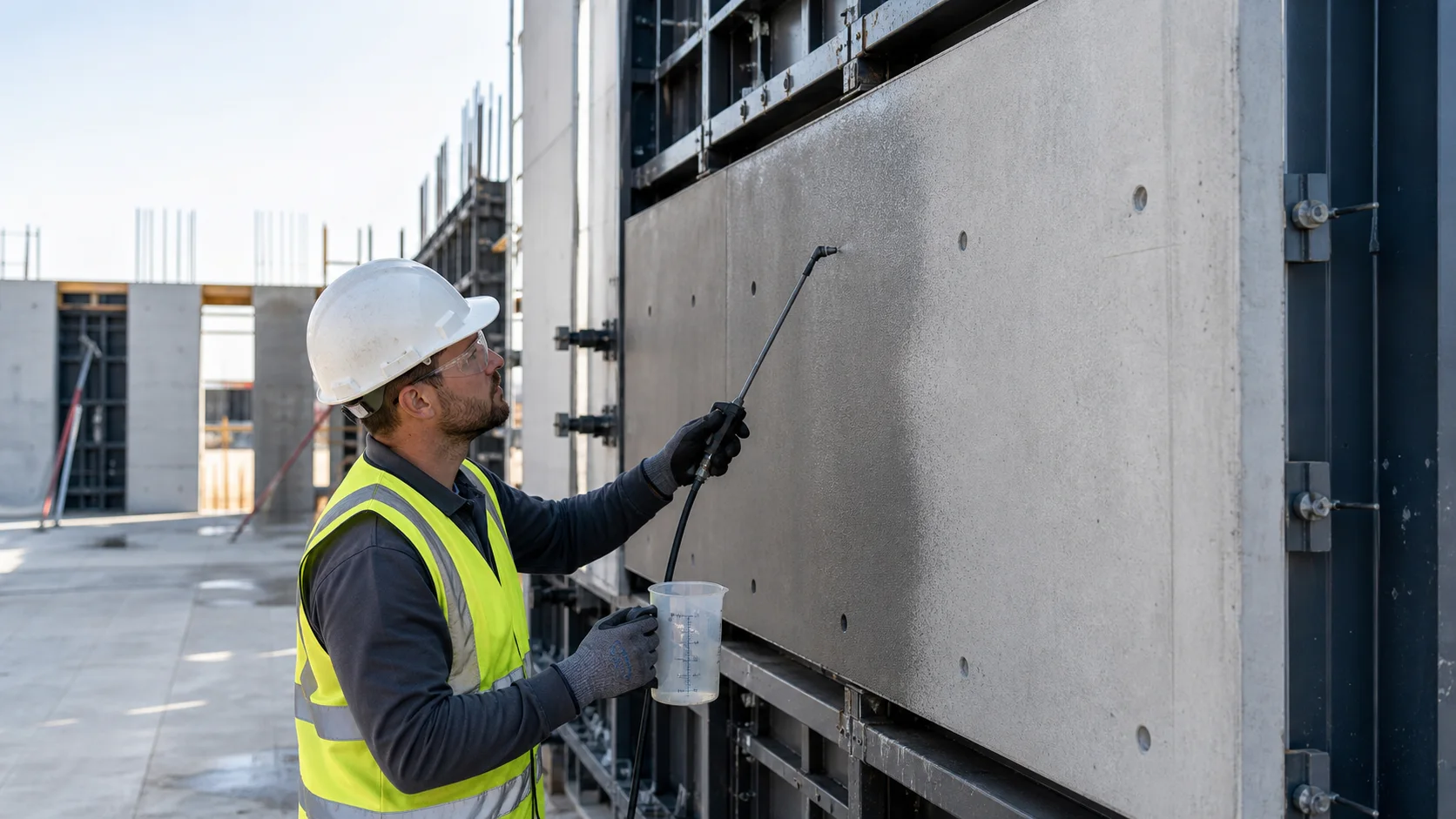
Release-agent consumption is often discussed as a product number, but the useful number on a construction site is a controlled result: how much mixed material is used on a known area of the actual formwork, with an acceptable surface after stripping.
That result is not the same for every panel. Steel, plywood, plastic liners, repaired surfaces, old panels, and absorbent form faces can all require different application control. The sprayer, nozzle, operator, dilution, weather, and waiting time also change the outcome.
This guide explains how to calculate a project-specific coverage rate without turning one product data point into a universal rule. For the application sequence, also read Release Agent Application: Spraying, Coverage, and Quality Control.
What the Coverage Rate Should Tell You
A useful coverage record should answer four practical questions:
- How much mixed release agent was used on a known formwork area?
- Was the film continuous without missed strips, overlap bands, or pooling?
- Did the concrete release cleanly without staining or unexpected surface defects?
- Can the same application result be repeated by another operator or on the next pour?
The objective is not to use the smallest possible amount. The objective is to identify the lowest repeatable application level that satisfies release and appearance requirements for that formwork system.
Why One Fixed Number Can Mislead
Coverage changes when the interface changes. Before copying a number from another project, check the following variables:
| Variable | Why it changes the result |
|---|---|
| Formwork material | Steel, wood, plastic, coated, and repaired faces differ in absorption and surface energy. |
| Surface condition | Dust, cement paste, sanding, old residue, and moisture affect how the film spreads. |
| Product and dilution | Ready-to-use and concentrated products cannot be compared on the same basis. |
| Sprayer and nozzle | Pressure, spray pattern, distance, and overlap change transfer to the panel. |
| Operator and sequence | Walking speed, trigger control, and pass direction affect film uniformity. |
| Weather and panel temperature | Drying, evaporation, and visible pooling change with site conditions. |
Two teams can report the same number of liters per square meter while producing different results if one team measures concentrate and the other measures diluted material. Always label the basis of the measurement.
The Basic Calculation
For a site trial, calculate the mixed-material coverage first:
Mixed release-agent consumption per square meter
= amount of mixed material used / coated formwork area
For example, if a known panel area uses 8 liters of diluted material during a controlled application, the result is 8 liters divided by the coated area. The example is only a calculation method; it is not a universal application recommendation.
If the product is diluted, record both quantities:
Concentrate consumption
= mixed material used x concentrate fraction
Water added
= mixed material used x water fraction
Do not assume that a ratio written as “1:5” means the same thing in every document. Confirm whether the manufacturer means one part product plus five parts water, or a different mixing convention. The product technical data sheet should control the calculation.
A Practical Coverage Test
1. Measure the representative area
Choose a panel that represents production. Include the formwork material, repairs, joints, corners, and reuse condition that the project will actually contain. Measure the coated area, not the total size of a stack of panels.
2. Prepare the formwork as planned
Clean dust, loose cement paste, old residue, and debris before application. Record whether the face is dry, damp, new, reused, repaired, or coated. A coverage result from a clean laboratory panel may not transfer to a contaminated production panel.
3. Record the starting quantity
Measure the prepared mixture before spraying. When practical, weighing the container before and after application gives a more reliable record than reading a small volume difference, especially when the liquid can cling to the tank or hose.
Record the product, batch, dilution, container weight or volume, sprayer, nozzle, pressure setting, operator, and application date.
4. Apply with production equipment
Use the same sprayer, nozzle, pass direction, distance, and walking speed planned for the pour. Do not quietly change to a brush or a different nozzle for the test unless that is the variable being evaluated.
Look for missed edges, heavy overlap, corner pooling, and dry-looking strips. The target is a thin, even film. A very wet or glossy panel is not automatically better covered.
5. Measure the remaining quantity
Measure the remaining material after the panel is complete. Subtract the remaining quantity from the starting quantity and divide by the actual coated area. Record the result as mixed-material consumption and, separately, calculate the concentrate consumption if needed.
6. Confirm the result after stripping
Coverage is not accepted by the spray pattern alone. After the relevant waiting, casting, curing, and stripping sequence, inspect both surfaces:
- clean release without tearing or sticking;
- uniform color without dark or oily shadows;
- no new concentration of bugholes or drag marks;
- no heavy residue or cement paste bonded to the form;
- acceptable cleaning and reuse condition.
If release is good but color or residue is poor, the film may be too heavy or unsuitable for the surface target. If the center releases well but corners stick, review the application pattern and form preparation rather than simply increasing the amount everywhere.
How to Set an Operating Range
Do not turn one successful panel into a rigid number immediately. Repeat the trial on the representative formwork systems used on the project. Then define:
- a target application result for the operator;
- an operating range for normal variation;
- a trigger for stopping and checking the panel;
- an acceptance record after stripping.
The range should be based on repeatable release and appearance, not only on material savings. A low consumption number that produces missed coverage or rework is not an efficient result.
Signs of Too Little or Too Much
| Observation | First variables to review |
|---|---|
| Sticking or surface tearing | Missed coverage, dirty form, incompatible surface, early stripping, or insufficient film. |
| Dark or oily shadows | Pooling, heavy overlap, excessive film, wet casting, or unsuitable product. |
| Defects at edges and corners | Spray angle, access, drainage, joints, and local residue. |
| Good release but poor color | Over-application, product residue, formwork variation, or concrete process changes. |
| Large variation between operators | Different speed, pressure, nozzle distance, pass overlap, or mixing practice. |
Use the observation to guide a controlled retest. Changing several variables at the same time makes the coverage record difficult to trust.
A Simple Site Record
| Check | Record |
|---|---|
| Formwork | Material, area, reuse count, repairs, cleanliness, moisture |
| Product | Name, batch, ready-to-use or concentrate, dilution convention |
| Equipment | Sprayer, nozzle, pressure, distance, operator |
| Quantity | Starting amount, remaining amount, mixed consumption, concentrate consumption |
| Application | Passes, overlap, corners, missed areas, drying time |
| Concrete result | Release, color, residue, bugholes, drag marks, surface acceptance |
| Decision | Accept, adjust and retest, or reject for this system |
Conclusion
A useful release-agent coverage rate is a measured process result, not a number copied from a different project. Measure a representative area, record the mixed and concentrate quantities separately, use production equipment, and confirm the result after stripping.
The best target is a thin, continuous, repeatable film that protects the concrete appearance and formwork reuse cycle. For product selection and technical support, review the concrete release-agent options on the main site.